
How to Take an AI Security Startup to Market


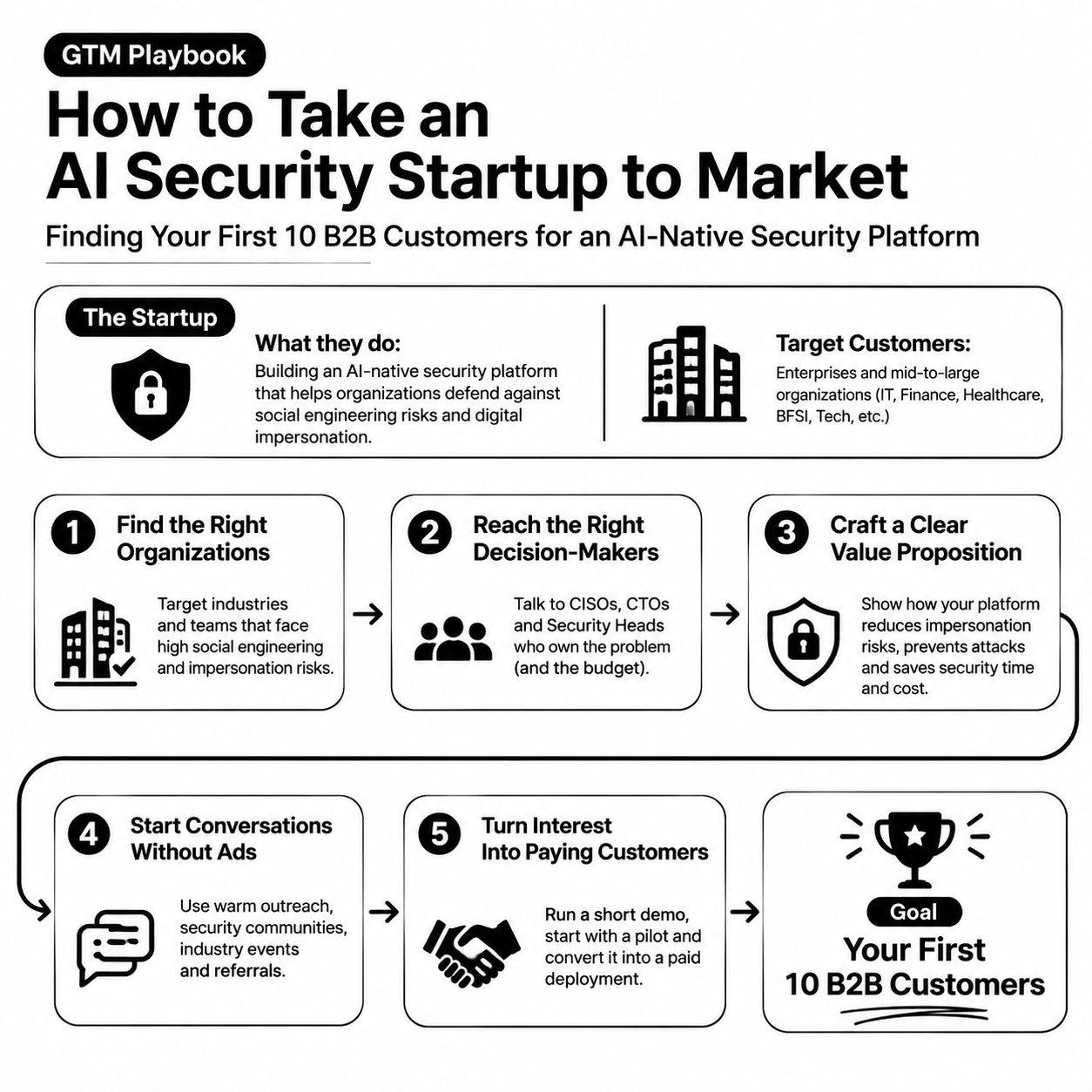
A Practical GTM Playbook to Find Your First 10 B2B Customers
Building a great AI product is only half the journey. Getting the right businesses to trust it, test it and pay for it is where the real challenge begins.
Imagine you've built an AI-native security platform that helps organizations defend against social engineering attacks and digital impersonation.
Your technology works. Your product is ready. But how do you convince a company to actually buy it?
You can't simply send hundreds of emails saying, "We have an AI security solution."
You need a Go-To-Market (GTM) strategy.
Let's break it down.
1. Identify the Businesses That Actually Need Your Product
Your first mistake could be trying to sell to every company.
Not every organization has the same security challenges, budget or urgency.
Start by identifying businesses that face significant risks from impersonation and social engineering.
Potential customer segments:
- Banking and Financial Services
- Healthcare organizations
- IT and technology companies
- Large enterprises
- Businesses handling sensitive customer information
Think about this: Who experiences the problem most frequently, and who has the authority and budget to solve it?
Your goal is to find a specific customer segment before expanding into other markets.
2. Find the People Who Make Buying Decisions
Once you identify your target organizations, the next step is finding the right people.
Selling a B2B security product requires reaching people who understand the business risk and can influence purchasing decisions.
Your potential decision-makers:
- CISO: Responsible for organizational information security.
- CTO: Evaluates technology and technical infrastructure.
- Head of Security: Oversees security operations and risk management.
- IT Director: Evaluates technology implementation and operational requirements.
Don't approach everyone with the same message.
Understand their responsibilities and explain how your product addresses a problem they care about.
3. Build a Value Proposition That Businesses Understand
Here's an important difference:
A company doesn't necessarily want to buy another AI tool. It wants to solve a business problem.
Instead of saying:
"We have developed an advanced AI-powered security platform."
Explain the business value:
"Our platform helps organizations identify and defend against social engineering risks and digital impersonation."
A strong value proposition should answer three questions:
- What problem does your product solve?
- Why is your solution different?
- What business value can the customer expect?
Remember: Sell the outcome, not just the technology. Avoid promising security results that you haven't demonstrated.
4. Start Customer Conversations Without Running Ads
Early-stage startups don't always need a large advertising budget to begin acquiring customers.
They need to reach the right people and build meaningful relationships.






Add your perspective
Sign in to comment, like, and build your reputation.