
How to Become a GenAI Engineer: A Beginner's Learning Roadmap


You use ChatGPT to write content, generate ideas and solve problems.
But have you ever wondered how these AI applications actually work?
How do developers build AI chatbots? How can an application understand documents? And how do AI agents perform tasks?
If you're interested in building these technologies, becoming a Generative AI (GenAI) Engineer could be an interesting career path.
But where should you start?
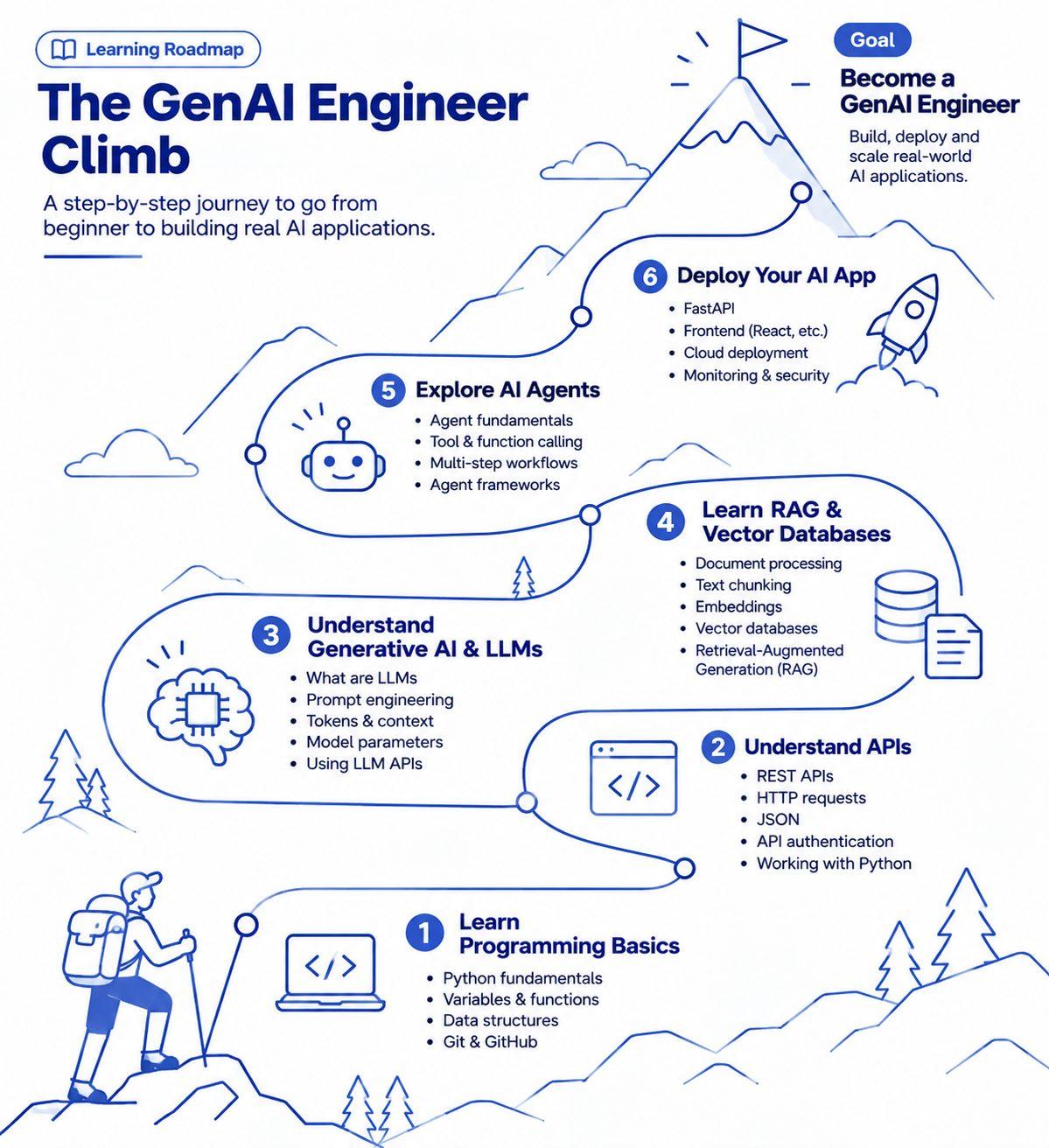
Let's break it down into a practical learning roadmap.
Step 1: Learn the Programming Fundamentals
Before building AI applications, understand the basics of programming.
What to learn:
- Python fundamentals
- Variables, functions and loops
- Data structures
- Object-oriented programming
- Git and GitHub
Practice project: Build a simple Python-based calculator or task manager.
Step 2: Understand How APIs Work
AI applications often connect different services through APIs.
You should understand how applications send requests, receive responses and work with external services.
What to learn:
- REST APIs
- HTTP requests and responses
- JSON
- API authentication
- Working with Python requests
Practice project: Connect a Python application to a public API and display its response.
Step 3: Understand Generative AI and LLMs
Now it's time to understand the technology behind modern AI applications.
What to learn:
- What Large Language Models (LLMs) are
- How prompts influence responses
- Tokens and context windows
- Model parameters
- Prompt engineering
- AI model APIs
Practice project: Build a basic AI-powered question-answering application.
Step 4: Learn RAG and Vector Databases
What if you want an AI application to answer questions from your own documents?
This is where Retrieval-Augmented Generation (RAG) becomes useful.
What to learn:
- Document processing
- Text chunking
- Embeddings
- Vector databases
- Semantic search
- Retrieval-Augmented Generation
Practice project: Build an AI PDF Assistant that lets users upload documents and ask questions about them.
Step 5: Explore AI Agents
A chatbot responds to questions. An AI agent can also use tools and perform tasks as part of a workflow.
What to learn:
- AI agent fundamentals
- Tool calling
- Function calling
- Multi-step workflows
- Agent frameworks
- Human-in-the-loop workflows
Practice project: Build an AI research assistant that searches information, organizes findings and generates a report.
Step 6: Deploy Your AI Application
Building an application is only one part of the journey. You should also learn how to make it accessible to other people.
What to learn:
- FastAPI
- Basic frontend development
- Environment variables and API key security
- Cloud deployment
- Application monitoring
Practice project: Deploy one of your AI projects so other people can use it.
What Should Your Portfolio Look Like?
By the end of this learning journey, aim to have three projects you can demonstrate:
- AI Chatbot: An application connected to an LLM API.
AI PDF Assistant: A document-based question-answering application






Add your perspective
Sign in to comment, like, and build your reputation.