
Agentic AI: A Complete Framework. 𝗕𝗲𝗰𝗼𝗺𝗲 𝗯𝗲𝘁𝘁𝗲𝗿 𝗮𝘁 𝗔𝗜 𝗶𝗻 𝗷𝘂𝘀𝘁 𝟭 𝗺𝗶𝗻𝘂𝘁𝗲

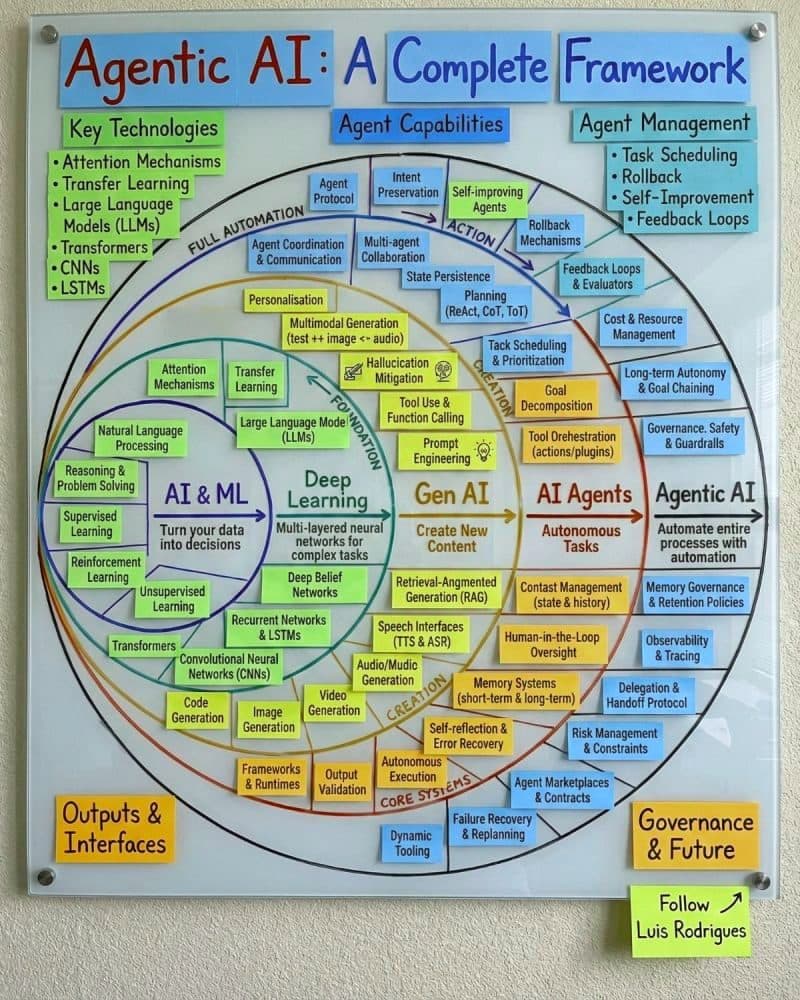
Everyone is talking about AI models.
They're missing 4 other layers.
Most people treat Agentic AI like it's just “ChatGPT + a few tools”.
It’s not.
Agentic AI has five layers, and all of them matter.
Every week in my newsletter: Build What Matters
I write about AI agents + emerging workflows.
Subscribe Here 👉 https://lnkd.in/dtS9MGWM
𝟭/ 𝗔𝗜 & 𝗠𝗟 (𝗧𝗵𝗲 𝗙𝗼𝘂𝗻𝗱𝗮𝘁𝗶𝗼𝗻)
This is where data becomes decisions.
These methods learn from data to classify, predict, or optimize decisions.
Classic ML sits here: Supervised, unsupervised, reinforcement.
𝟮/ 𝗗𝗲𝗲𝗽 𝗟𝗲𝗮𝗿𝗻𝗶𝗻𝗴 (𝗧𝗵𝗲 𝗘𝗻𝗴𝗶𝗻𝗲)
Neural nets. Transformers.
Neural networks learn hierarchical representations: edges → shapes → concepts.
They power modern perception and language systems.
𝟯/ 𝗚𝗲𝗻𝗔𝗜 (𝗧𝗵𝗲 𝗖𝗿𝗲𝗮𝘁𝗶𝘃𝗲)
LLMs generate the output.
Foundation models generate new content from learned patterns.
RAG pulls in the missing context and grounds outputs in external knowledge.
This is the generation layer: multimodal models span text, image, audio, and video.
𝟰/ 𝗔𝗜 𝗔𝗴𝗲𝗻𝘁𝘀 (𝗧𝗵𝗲 𝗘𝘅𝗲𝗰𝘂𝘁𝗶𝗼𝗻)
This is where AI starts doing real work.
→ Planning. ReAct, Chain-of-Thought, Tree-of-Thought.
→ Tool use. Orchestration.
→ Context handling. State and history.
→ Human-in-the-loop control.
𝟱/ 𝗔𝗴𝗲𝗻𝘁𝗶𝗰 𝗔𝗜 (𝗧𝗵𝗲 𝗦𝘆𝘀𝘁𝗲𝗺)
Autonomy, but deployed in the real world.
→ The most neglected layer.
→ Governance. Safety. Guardrails.
→ Observability and tracing. "Why did it do that?"
→ Memory governance. Retention policies.
→ Rollback. Failure recovery.
→ Cost management. Resource management.
→ Multi-agent coordination.
Smart algorithms don’t automatically become dependable systems.
You need audit trails, debugging, reversibility, and hard boundaries to build real autonomy.
Are you building with AI or using AI in your projects? If you want to learn more and go deeper into AI Engineering, with a structured, guided and personalized learning path?, start with these courses & resources:
1. Engineering with Foundation Models
Best for the LLM layer: foundation models, how they generate responses, and how to build applications around them.
2. Building RAG and Agentic Systems
Best for retrieval, indexed knowledge bases, grounded generation, tool use, agent loops, and workflow orchestration.
3. Generative AI Design Patterns
Add your perspective
Sign in to comment, like, and build your reputation.